The short answer: smoke odor survives almost every DIY attempt because it isn’t on surfaces, it’s inside them.
When something burns in a home, the smoke doesn’t just drift through the air and disappear. Tiny acidic particles and volatile organic compounds (VOCs) penetrate drywall, insulation, wood framing, upholstery fibers, and HVAC ductwork within hours. What you smell weeks later isn’t a surface stain you missed, it’s off-gassing from materials that absorbed those particles at a molecular level. Professional smoke odor removal works because it addresses that chemistry directly. Candles, sprays, and plug-in air fresheners don’t. They layer a new smell on top of the old one and call it done.
Why Smoke Odor Is So Stubborn
Smoke from a house fire or even a contained kitchen fire is a complex mixture. The exact composition depends on what burned: synthetic materials like carpet and foam produce different chemical residues than wood or paper. But across all of them, the particles are small enough to travel through gaps in drywall seams, settle inside electrical outlets, and coat the interior surfaces of ductwork.
A few things that make smoke odor especially persistent:
- Protein smoke from cooking fires (burned meat, grease) is nearly invisible but leaves a thin, foul-smelling film on every surface it contacts. It doesn’t wipe off easily because it bonds to paint and finishes.
- Synthetic smoke from burning plastics or foam contains soot that is oily and acidic. Left untreated, it continues to etch and discolor surfaces over time.
- Porous materials like drywall, wood trim, insulation, and fabric act like sponges. Once smoke particles are inside them, they slowly release odor back into the air for months.
- HVAC systems distribute smoke particles to every room in the house, even rooms far from the fire, during and after the event.
Understanding this is important before you spend money on anything, because it tells you where the problem actually lives.
What DIY Methods Do (and Don’t Do)
Most homeowners reach for one of a handful of approaches. Here’s what each one actually accomplishes:
Baking soda and vinegar: These neutralize some surface odors and are fine for minor cooking smells. They do not penetrate drywall, insulation, or subflooring. They have no meaningful effect on smoke from a structural fire.
Ozone machines (rented or purchased): Ozone generators are legitimate professional tools when used correctly, but rental units are typically lower-output than commercial equipment, and safe ozone treatment requires the space to be completely vacated for extended periods. Underexposure doesn’t work; overexposure damages rubber seals, electronics, and plants. Without proper concentration monitoring, results are inconsistent.
Thermal foggers: Again, a real professional tool that works by dispersing a deodorizing agent as a fine mist that penetrates the same spaces smoke did. Consumer-grade versions exist, but the chemistry in the fog matters as much as the equipment. Using the wrong agent in the wrong concentration can leave its own residue.
Repainting: Paint seals surface odors temporarily. Within weeks to months, odor molecules migrate back through the new paint layer. Professionals seal smoke-damaged surfaces with shellac-based or specialized odor-blocking primers before any finish coat goes on. Standard latex primer does not do this.
Air purifiers with HEPA filters: Useful for capturing airborne particles during and after remediation. Not a solution on their own. They clean the air; they don’t treat the surfaces releasing odor into that air.
The pattern across all of these: they address air or surface, not the materials underneath.
What Professionals Actually Do
A trained smoke odor remediation crew approaches the job in layers, working from the chemistry outward.
1. Assess the scope. Before any treatment, technicians identify what burned, what areas were affected (including HVAC zones), and what materials are salvageable versus what needs to be removed. Drywall with heavy smoke saturation is often more cost-effective to replace than to treat repeatedly.
2. Remove unsalvageable materials. Heavily saturated insulation, charred framing, and destroyed contents come out first. You cannot deodorize material that is itself the source.
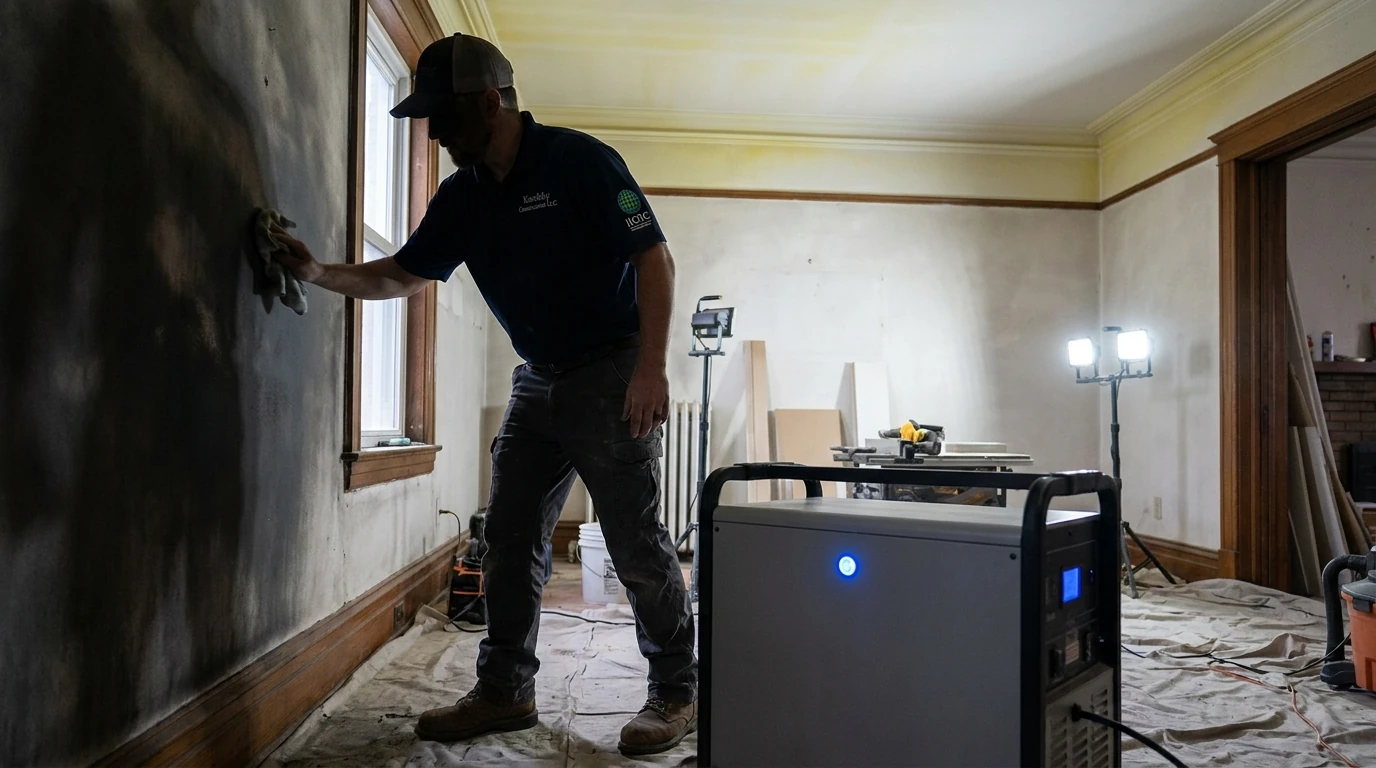
3. Clean all surfaces. Soot is removed using dry chemical sponges (which lift oily soot without smearing it) and appropriate cleaning agents matched to the surface type. This step is methodical and slow. Walls, ceilings, trim, inside cabinets, inside closets, and inside the HVAC system all get attention.
4. Apply sealers to porous surfaces. Shellac-based primers or purpose-built odor sealers are applied to structural surfaces before any reconstruction begins. This locks in residual odor molecules that cleaning didn’t fully reach.
5. Treat the air and remaining contents. Depending on the severity, this may involve hydroxyl generators (which use UV light to break down VOCs and are safe to operate in occupied or semi-occupied spaces), commercial ozone treatment (in vacated spaces), or thermal fogging with appropriate chemistry.
6. Clean or replace HVAC components. Ductwork is cleaned, and filters are replaced. If the system ran during or after the fire, every room it serves received smoke-laden air.
7. Verify. A final air quality check and walkthrough confirms the odor is gone, not masked.
This process takes time, specialized equipment, and chemistry knowledge. Skipping any layer typically means the odor returns.
When to Call a Professional (and When You Might Not Need To)
Not every smoke situation requires full professional remediation. Here’s a rough guide:
You can probably handle it yourself if: A single small item burned (a forgotten pan on the stove), the smoke was contained to one room, you ventilated immediately, and the smell dissipates within a day or two on its own.
Call a professional if:
- The smell persists more than 48 hours after thorough ventilation.
- The fire involved synthetic materials, upholstered furniture, or anything structural.
- The HVAC system was running during or after the fire.
- You can see soot on walls, ceilings, or inside cabinets in rooms away from where the fire occurred.
- Your insurance company is involved (professional documentation of scope and process matters for claims).
- Anyone in the household has respiratory sensitivities or conditions.
Smoke residue is also acidic and continues to damage surfaces while you wait. The longer porous materials stay contaminated, the deeper the penetration and the harder the remediation.
The Longer Recovery: What Comes After Odor Removal
Once the odor source is addressed, there is often reconstruction work to do: replacing drywall, repainting with appropriate sealers, restoring or replacing trim, and sometimes replacing flooring or cabinetry. Smoke remediation and structural repair frequently overlap, which is why working with a contractor who understands both the restoration and the rebuild side matters.
If your home has experienced fire or smoke damage in the Pittsburgh area, Katofsky Construction LLC handles both the smoke damage restoration and the fire damage restoration work that follows. Reach them at (412) 304-9284 to talk through what you’re dealing with before deciding on a path forward.