24/7 Emergency Board-Up and Tarping in Pittsburgh
24/7 emergency board-up and tarping in Pittsburgh and surrounding areas. IICRC-certified, insurance billing accepted. Call (412) 304-9284.
A broken window at 2 a.m., a roof torn open by a storm, a door frame blown out by a fire department’s forced entry, every hour that opening stays exposed, the damage compounds. Rain soaks into subfloor and drywall. Looters read an unboarded window as an invitation. Insurers look at the claim timeline and ask whether the property was secured promptly. Emergency board-up and tarping is the work that stops the clock on secondary damage, and it has to happen before anything else.
What emergency board-up and tarping actually involves
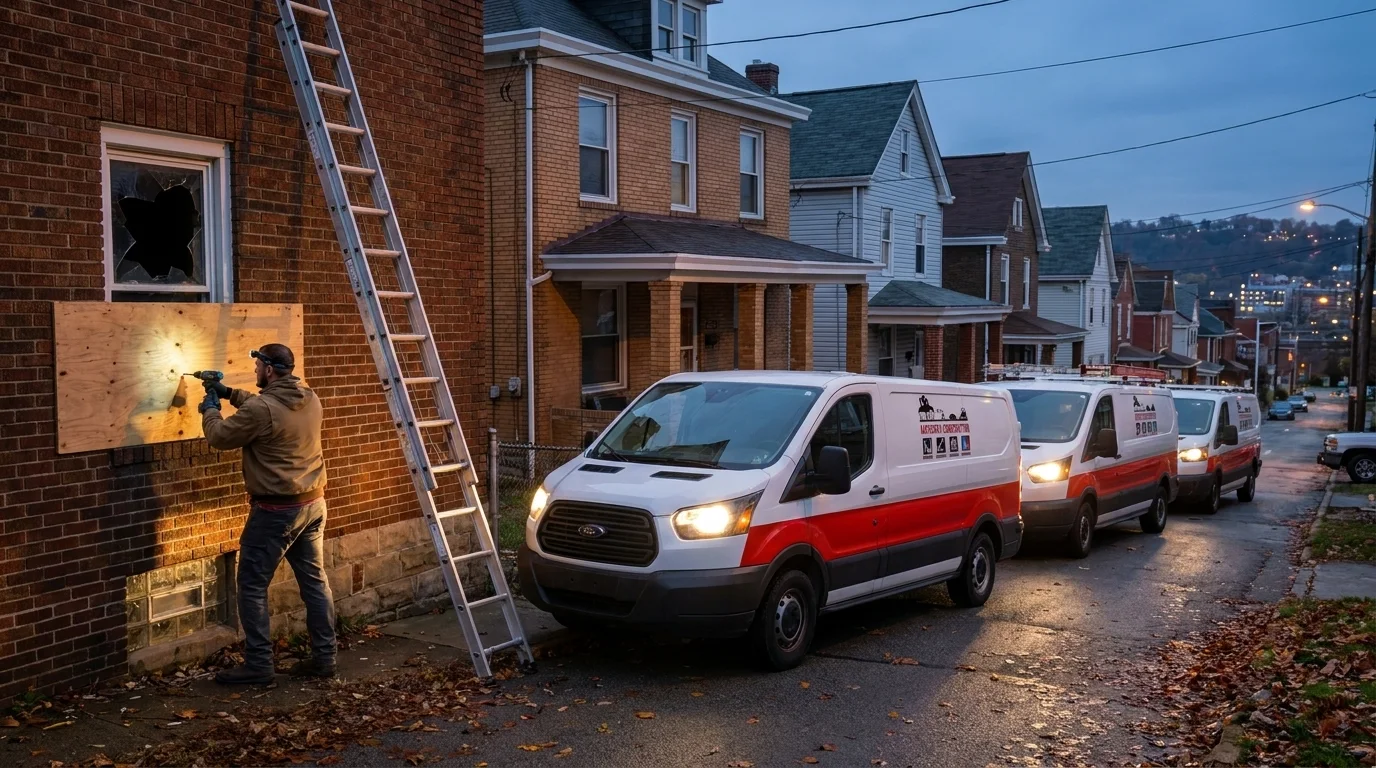
Board-up and tarping is structural security and weather protection, installed fast. On the board-up side, that means cutting plywood to fit window and door openings, anchoring it to the framing (not just the sill), and sealing gaps that would let wind-driven rain through. On the roof side, it means laying heavy-duty poly tarps over damaged or missing sections, weighting or fastening the edges so the tarp stays put through wind, and routing runoff away from any open penetrations.
The work requires more than a tarp from a hardware store. Crews assess the structural condition of the opening before climbing onto a compromised roof. They identify which sections of sheathing are intact enough to anchor to, and they use mechanical fasteners rather than relying on weight alone. For fire-damaged structures, they also assess whether the wall framing near an opening can bear the load of a plywood panel before attaching it.
A properly executed board-up is weather-tight and tamper-resistant. It also photographs well, which matters when an adjuster reviews the claim.
Our process
-
Damage assessment on arrival. Before any material goes up, the crew walks the perimeter and identifies every opening, every compromised roof section, and any structural hazards that affect how the work gets done safely. A fire-damaged wall stud that looks solid can be charred through at the core.
-
Roof tarping first when weather is the active threat. If rain is falling or forecast, the roof gets covered before windows are boarded. Tarp edges are secured with battens or weighted with sandbags, and the crew checks that water drains away from the opening rather than pooling under the tarp.
-
Plywood cutting and fitting. Panels are cut to the rough opening, not just leaned against the frame. Fasteners go into structural framing members. On fire-damaged openings, the crew avoids attaching to framing that shows deep char without first checking load capacity.
-
Perimeter seal and secondary openings. Gaps around HVAC penetrations, attic vents, and crawl space accesses that were exposed by the loss event get addressed. A boarded front window does not help if a soffit vent is open to the interior.
-
Documentation for your claim. The crew photographs every opening before and after work, notes the materials used, and provides a written scope. That documentation goes directly to your insurance carrier.
What separates a good board-up response from a bad one
The most common failure is speed without thoroughness. A crew that nails a single sheet of plywood over the most visible opening and leaves has not secured the property. Adjusters routinely find secondary water intrusion through gaps that were never addressed, and that additional damage can complicate coverage if the carrier argues it was preventable.
A second common problem is improper tarp installation on roofs. A tarp that is not fastened to solid decking, or one that routes water toward an open penetration rather than away from it, can cause more water intrusion than no tarp at all. On steep-pitch roofs or fire-weakened decking, this is also a safety issue for the crew.
Insurance adjusters look at three things in the documentation: whether the property was secured promptly after the loss event, whether all openings were addressed, and whether the materials used were appropriate for the conditions. Photographs taken before and after, with timestamps, answer all three.
What does emergency board-up and tarping cost?
Typical costs depend on the number of openings, roof pitch and access difficulty, material size, and whether the structure has fire or storm damage that complicates safe access. Most homeowners pay somewhere in the ranges below, based on industry-typical figures.
| Scenario | Typical range |
|---|---|
| Single window board-up | $150 - $400 |
| Multiple windows and doors (storm or fire) | $500 - $1,500 |
| Small roof tarp (single section, accessible pitch) | $400 - $900 |
| Large or steep-pitch roof tarp | $900 - $2,500 |
| Full exterior board-up after structure fire | $1,500 - $4,000 |
| Combined board-up and roof tarping, major loss | $2,000 - $5,500 |
Every loss is different, and Katofsky Construction LLC provides a written scope before work begins so there are no surprises. Homeowners insurance typically covers emergency board-up and tarping as part of the covered loss, particularly when the work is performed promptly and documented properly.
Seasonal and regional considerations
Pittsburgh’s weather creates specific timing pressure. Freeze-thaw cycles from late fall through early spring mean that an unprotected roof opening or broken window can allow water intrusion that freezes overnight, expands, and widens the damage by morning. Summer thunderstorm season brings high wind and hail events that can open multiple roof sections at once. Older housing stock throughout the city, including the brick rowhouses common in neighborhoods like Lawrenceville, Polish Hill, and Beechview, often has aging flashing and underlayment that offers less secondary protection once the primary covering is compromised.
Service area
Katofsky Construction LLC responds to board-up and tarping calls throughout Pittsburgh and the surrounding region, including communities across Allegheny County and neighboring counties. The city-specific pages for this service cover individual communities in more detail.
If a storm, fire, or break-in has left your property exposed, call (412) 304-9284 to secure it now. Katofsky Construction LLC operates 24/7, documents everything for your claim, and works with all insurance carriers.
Frequently Asked Questions
Does homeowners insurance cover emergency board-up and tarping?
How is a roof tarp properly secured so it does not blow off or cause more water damage?
What should I do to protect my home while waiting for the board-up crew to arrive?
Why does it matter whether plywood is fastened into framing rather than just the window sill or casing?
Can board-up and tarping be installed on a structure that has already had fire department activity inside?
Looking for the best emergency board-up and tarping company in Pittsburgh?
Katofsky Construction LLC provides licensed and insured emergency board-up and tarping in Pittsburgh, PA and the surrounding area. We answer calls 24/7 — call (412) 304-9284 for immediate help.
Need Emergency Board-Up and Tarping now?
We respond 24/7 across Pittsburgh and surrounding PA cities.
Related Coverage
- Our Restoration Services
- Contact Katofsky Construction LLC
- Roofing Installation and Replacement in Pittsburgh
- 24/7 Emergency Fire Damage Restoration in Pittsburgh
- 24/7 Emergency Sewage Cleanup and Sanitization in Pittsburgh
- Renovations, Remodels and General Contracting in Pittsburgh
- 24/7 Emergency Biohazard Cleanup in Pittsburgh
- 24/7 Emergency Board-Up and Tarping in Baldwin
- 24/7 Emergency Board-Up and Tarping in Bethel Park
- 24/7 Emergency Board-Up and Tarping in Carnegie
- 24/7 Emergency Board-Up and Tarping in Green Tree
- 24/7 Emergency Board-Up and Tarping in Greensburg
- 24/7 Emergency Board-Up and Tarping in Hempfield Township
- 24/7 Emergency Board-Up and Tarping in Jeannette
- 24/7 Emergency Board-Up and Tarping in Latrobe
- 24/7 Emergency Board-Up and Tarping in Lower Burrell
- 24/7 Emergency Board-Up and Tarping in McCandless
- 24/7 Emergency Board-Up and Tarping in McKeesport
- 24/7 Emergency Board-Up and Tarping in Monroeville