IICRC Certification Tells You One Thing Immediately
When a pipe bursts or mold appears behind your drywall, you’re not shopping for a contractor the way you’d shop for a kitchen remodel. You’re making a fast decision under stress, often while water is still moving. IICRC certification is the clearest single signal that the technician walking into your home has been trained to a documented industry standard, not just handed a wet-vac and a truck. It stands for the Institute of Inspection, Cleaning and Restoration Certification, and it sets the technical benchmarks that govern how water damage, mold, and fire residue are actually supposed to be handled.
What the IICRC Actually Is
The IICRC is an independent, accreditation-body that publishes standards used across the restoration industry. The most referenced ones are the S500 (water damage restoration), the S520 (mold remediation), and the S700 (fire and smoke restoration). These aren’t marketing documents. They define things like acceptable moisture content in structural materials before a space can be declared dry, the containment protocols required during mold work, and the chemistry behind neutralizing smoke odor versus masking it.
When a technician earns an IICRC credential, they’ve passed a written exam on that specific standard. The most common entry-level credential is the WRT (Water Restoration Technician). From there, technicians can earn Applied Structural Drying (ASD), Applied Microbial Remediation Technician (AMRT), Fire and Smoke Restoration Technician (FSRT), and others. Each one requires coursework, an exam, and ongoing continuing education to maintain.
The firm-level credential is called Certified Firm status. A company earns it by having certified technicians on staff, maintaining insurance, and agreeing to a code of ethics. It’s worth asking a contractor specifically which credentials their on-site technicians hold, not just whether the company name appears in the IICRC directory.
Why Certification Matters More in Restoration Than in Most Trades
A poorly installed tile floor is ugly. A poorly executed water mitigation job can leave moisture inside wall cavities that won’t show up on the surface for weeks, and by then mold has already colonized the paper facing on your drywall. The consequences of substandard restoration work are often invisible at first and expensive later.
Here’s what certification actually changes on the job:
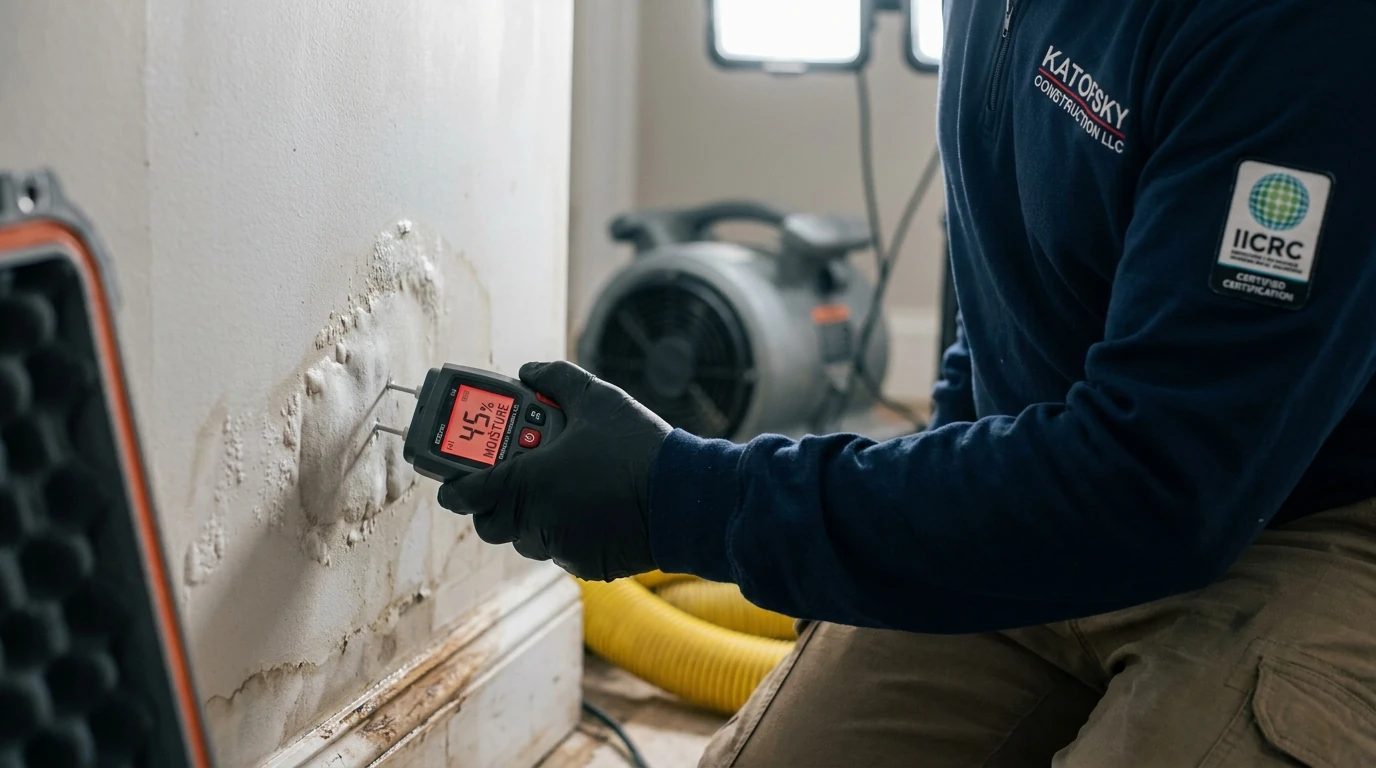
- Moisture mapping: An IICRC-trained technician uses thermal imaging and calibrated moisture meters to find water that has wicked behind baseboards, into subfloor assemblies, or up into wall cavities. A non-trained crew may dry what they can see and call it done.
- Drying targets: The S500 standard defines specific equilibrium moisture content targets for different materials. A certified tech knows that hardwood flooring dries differently than OSB subfloor, and sets equipment accordingly.
- Containment during mold work: The S520 standard requires containment barriers and negative air pressure during active mold remediation to prevent cross-contamination to unaffected areas. Skipping this step can spread spores to rooms that were previously clean.
- Documentation: Certified restorers log psychrometric readings (temperature, humidity, moisture content) throughout the drying period. This documentation matters when you file an insurance claim, because adjusters and independent inspectors can verify that the work was performed to standard.
None of this is secret knowledge. It’s just knowledge that takes time to acquire and that not every contractor who owns a dehumidifier has bothered to learn.
What to Look for When Hiring a Restoration Contractor
Certification is a floor, not a ceiling. Here’s a practical checklist for evaluating any restoration contractor before you let them start work:
- Ask which specific IICRC credentials the technicians who will be on your job hold. WRT is the baseline for water work. AMRT matters for mold. FSRT matters for fire and smoke. A company can be an IICRC Certified Firm while sending uncertified technicians to your job.
- Confirm they carry liability insurance and, if applicable, workers’ compensation. Restoration work involves cutting into walls, running high-amperage drying equipment, and working in potentially contaminated environments. You want coverage if something goes wrong.
- Ask how they document the drying process. If they can’t describe psychrometric logging or don’t plan to provide a drying report, that’s a gap.
- Understand the scope before work begins. A reputable contractor will walk through the affected area, explain what they’re finding with a moisture meter, and give you a written scope of work. Verbal estimates on a job this consequential leave too much room for misunderstanding.
- Check whether they work directly with your insurance carrier. Many certified restoration firms handle direct billing and documentation for claims, which removes the burden of fronting costs and chasing reimbursement.
For Pittsburgh homeowners, this last point is worth emphasizing. Older housing stock throughout the city, particularly the brick rowhouses and century-old frame construction common in neighborhoods like Lawrenceville, Polish Hill, and Beechview, often has plaster walls, knob-and-tube wiring in untouched spaces, and subfloor assemblies that behave very differently from modern OSB. A technician trained to the IICRC standard will know to adjust drying protocols for dense plaster rather than treating it like standard drywall.
What IICRC Certification Does Not Guarantee
This is worth saying plainly: certification is a credential, not a character reference. A certified technician can still run a disorganized job, communicate poorly, or cut corners on containment when no one is watching. Certification tells you the person has been trained. It doesn’t tell you how they behave on a Tuesday afternoon when the job is running long.
This is why reviews, references, and local reputation still matter alongside credentials. Look for contractors who can explain their process in plain language, who show you what the moisture meter is reading rather than just telling you the job is done, and who don’t pressure you to sign a work authorization before you’ve had time to read it.
Also worth noting: IICRC certification is specific to the restoration and cleaning industry. It is not a general contractor’s license, a plumbing license, or a mold inspector’s license. In Pennsylvania, mold remediation does not currently require a state license, which makes third-party credentialing like IICRC even more important as a quality signal, since there’s no state licensing floor to fall back on.
How This Connects to the Work at Your Property
Water damage, mold remediation, and fire and smoke restoration are the three categories where IICRC training has the most direct impact on outcomes. In each case, the work involves hidden damage, time-sensitive decisions, and consequences that compound if the initial response is wrong.
For water damage, the first 48 to 72 hours determine whether you’re dealing with a drying job or a mold remediation job. For mold, improper containment turns a localized problem into a whole-house problem. For fire and smoke, the chemistry of smoke residue means that surfaces not cleaned correctly within days will require more aggressive treatment later, and some odors become permanent if the wrong cleaning method is applied.
In each scenario, the technician’s training is the variable that most directly affects your outcome.
If you’re dealing with water damage, mold, or fire damage at a Pittsburgh property and want to understand your options, Katofsky Construction LLC handles all three. Call (412) 304-9284 to talk through what you’re seeing and what the next steps look like.