Lead Paint Abatement in Penn Hills
24/7 lead paint abatement in Penn Hills, PA. IICRC-certified, insurance billing accepted. Call (412) 304-9284.
Our IICRC-certified technicians are dispatched from our Pittsburgh, PA headquarters and are typically on-site in Penn Hills within 60 minutes of your call.
Penn Hills sits on Pittsburgh’s eastern edge, and its residential streets are lined with the kind of mid-century and pre-war housing stock that almost guarantees lead-based paint somewhere in the structure. Whether it’s a Cape Cod off Frankstown Road or a brick two-story near the older sections of the township, homes built before 1978 routinely carry lead paint on window sashes, door frames, porch columns, and interior trim. If you’re renovating, selling, or responding to a child’s elevated blood-lead result, lead paint abatement in Penn Hills requires a methodical, regulation-compliant approach, not a coat of encapsulant and a hope.
Why Penn Hills Properties See Lead Paint Issues
Allegheny County’s housing inventory skews older than much of the country, and Penn Hills reflects that pattern clearly. A significant share of the township’s single-family homes were built between the 1930s and the early 1970s, when lead-based paint was standard on both interior and exterior surfaces. The region’s freeze-thaw cycle is hard on painted surfaces: repeated contraction and expansion causes paint to crack, chalk, and flake, which is exactly how lead dust enters a home’s living environment. Older double-hung windows are a particular concern because the friction between sash and frame grinds painted surfaces against each other every time the window moves, generating fine lead-contaminated dust at sill level where children spend time.
Exterior surfaces face additional stress from Pittsburgh’s humid summers and cold, wet winters. Peeling paint on soffits, fascia, and porch floors is common on homes throughout the township, and that deteriorating paint can migrate into soil around the foundation, creating a secondary exposure pathway that abatement planning needs to account for.
Our Lead Paint Abatement Process in Penn Hills
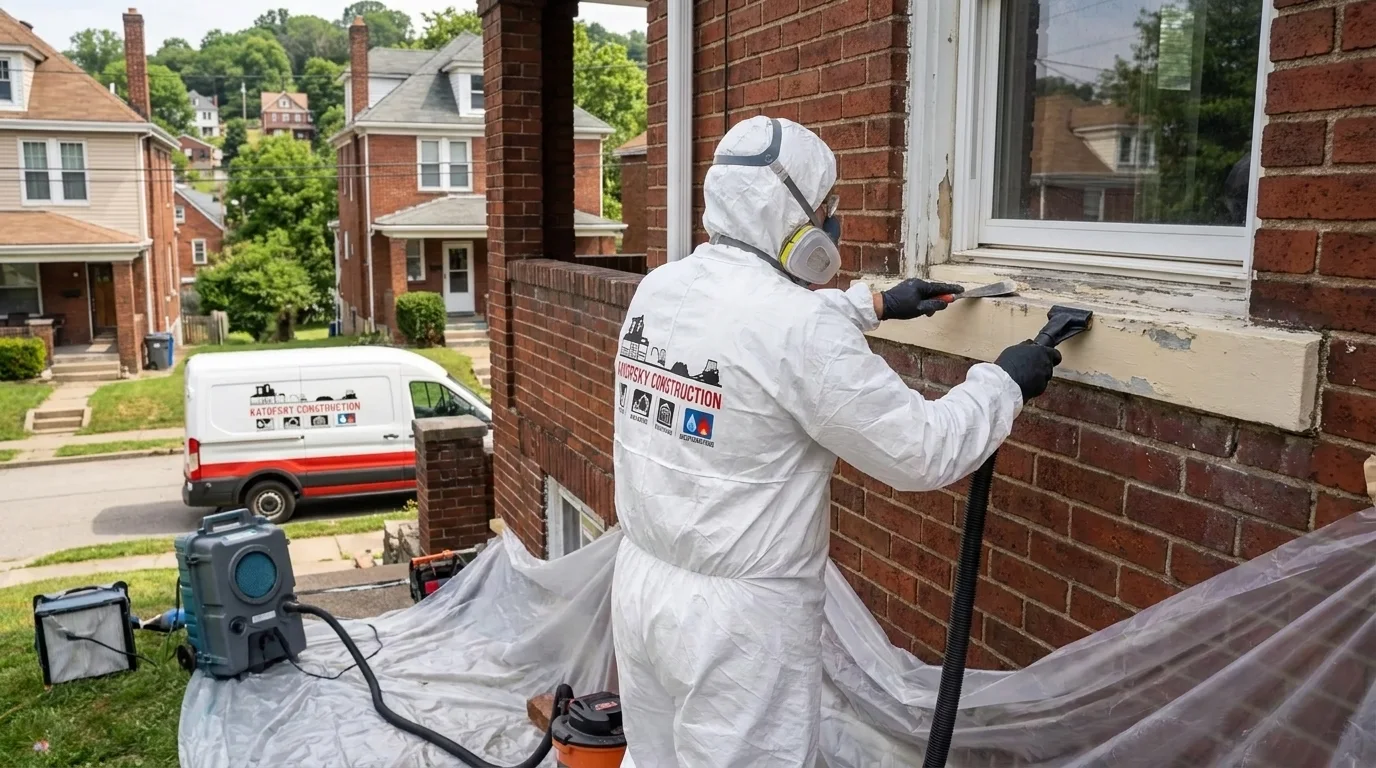
Every project starts with a thorough inspection and testing phase. We collect paint chip samples and use XRF analysis where appropriate to identify lead-bearing surfaces before any disturbance begins. That step matters because disturbing lead paint without knowing where it is can spread contamination rather than contain it.
Once the scope is defined, containment goes up before any removal starts: poly sheeting seals the work area, negative air pressure units with HEPA filtration run continuously, and all HVAC registers in the affected zone are sealed. Removal methods depend on the substrate and the condition of the paint. Wet scraping, chemical stripping, and HEPA-vacuum-assisted sanding are the standard approaches for residential work; heat guns above a safe threshold and dry sanding without HEPA control are not used, because both generate lead dust or fumes at concentrations that contaminate the rest of the home.
Waste is bagged, labeled, and disposed of as hazardous material through licensed disposal channels. After removal, the area is cleaned using HEPA vacuuming followed by wet washing, and clearance testing verifies that dust levels meet EPA standards before containment comes down. The documentation package we provide is suitable for real estate disclosure, contractor records, and health department requirements.
Reaching Penn Hills from Pittsburgh
Katofsky Construction LLC operates out of Pittsburgh, and Penn Hills is a straightforward drive east via the Penn Lincoln Parkway or Frankstown Avenue depending on the specific address. The township’s layout means that properties in different parts of the municipality can require different approach routes, but the proximity to Pittsburgh’s eastern corridors keeps scheduling efficient. We’re available around the clock, so if a home inspection flags a lead concern the day before a closing or a renovation crew uncovers suspect paint mid-project, you can reach us at (412) 304-9284 any time.
Local Note
One thing that comes up repeatedly in Penn Hills is the combination of original plaster walls and oil-based trim paint on pre-1950 homes. The plaster itself rarely contains lead, but the layers of oil-based paint on the woodwork surrounding it often do, and those layers can be thick, sometimes six or more coats built up over decades. Thick paint layers require a different removal strategy than thin latex topcoats: chemical strippers are often more appropriate than mechanical methods because they soften the paint without generating the fine airborne dust that mechanical abrasion produces. Knowing that going in saves time and keeps the air quality inside the containment zone manageable throughout the job.
What to Expect After Abatement
Once clearance testing confirms the work area is clean, the space is ready for whatever comes next, whether that’s a fresh coat of paint, new trim installation, or a full renovation. We provide a written clearance report and a record of all waste disposal. If your project involves a contractor who needs to continue work in the same area, we coordinate timing so the abatement and clearance phases don’t create unnecessary delays in the renovation schedule. For property owners dealing with a Pennsylvania Department of Health notification related to a child’s blood-lead level, we’re familiar with the documentation those cases require and can move quickly to help you meet any remediation timelines the health department has outlined.
Lead Paint Abatement in Penn Hills: Service Coverage
Frequently Asked Questions
How fast can you arrive for lead paint abatement in Penn Hills?
Are homes near the older sections of Penn Hills along Frankstown Road more likely to have lead paint?
Does Allegheny County or Penn Hills have specific requirements for lead abatement documentation?
How does Penn Hills' climate affect lead paint deterioration on exterior surfaces?
What is the difference between lead paint encapsulation and full abatement, and which is right for a Penn Hills home?
How long does a lead paint abatement project typically take in a Penn Hills single-family home?
Will my homeowners insurance cover lead paint abatement in Penn Hills?
Lead Paint Abatement response in Penn Hills
Most Penn Hills calls see a technician on-site within 60 minutes from our Pittsburgh headquarters.