24/7 Emergency Fire Damage Restoration in Penn Hills
24/7 emergency fire damage restoration in Penn Hills, PA. IICRC-certified, insurance billing accepted. Call (412) 304-9284.
Our IICRC-certified technicians are dispatched from our Pittsburgh, PA headquarters and are typically on-site in Penn Hills within 60 minutes of your call.
Fire damage emergency in Penn Hills? We answer 24/7. Call now and our crew heads out to secure the property and start the recovery.
Penn Hills sits on Pittsburgh’s eastern edge, where decades of dense residential development produced a housing stock that skews heavily toward mid-century construction, brick exteriors, plaster-and-lath interiors, and older electrical panels that can turn a small kitchen fire into a whole-house smoke event before the first engine arrives. When fire moves through that kind of home, the damage rarely stops at the char line. Soot travels through forced-air ductwork, smoke odor soaks into plaster, and structural members hidden behind original finishes absorb heat in ways that don’t show up on a visual walk-through. Katofsky Construction LLC responds to fire damage calls in Penn Hills around the clock, bringing the equipment and process discipline the job actually requires.
Why Penn Hills Homes Are Particularly Vulnerable After a Fire
Much of Penn Hills was built between the late 1940s and early 1970s, a period when homes were constructed with materials that behave very differently under fire and smoke conditions than modern building products. Plaster-and-lath walls, for instance, trap smoke particulate deep in the substrate. You can wipe the surface clean and still have odor-causing residue embedded in the plaster body itself. Older oil-based paints and varnishes, common in homes of that era, produce a dense, sticky soot when they burn that bonds aggressively to ceilings, trim, and cabinetry.
Electrical systems in homes from this period are another factor. Fuse boxes and early-generation breaker panels that have never been upgraded are more likely to experience overloads, and when a fire originates at the panel or in knob-and-tube wiring, the smoke pathway follows the wall cavities in ways that are hard to trace without thermal imaging. That hidden smoke migration is one of the most common reasons fire-damaged Penn Hills homes develop persistent odor problems even after a surface cleaning.
Our Fire Damage Restoration Process in Penn Hills
Every job starts with a thorough assessment before any cleaning or demolition begins. We use thermal imaging cameras to map heat-affected zones and track smoke migration through wall cavities and floor assemblies. This matters especially in older Penn Hills construction, where plaster walls and original hardwood floors can conceal damage that isn’t visible to the eye.
Once the scope is documented, the process moves in a deliberate sequence:
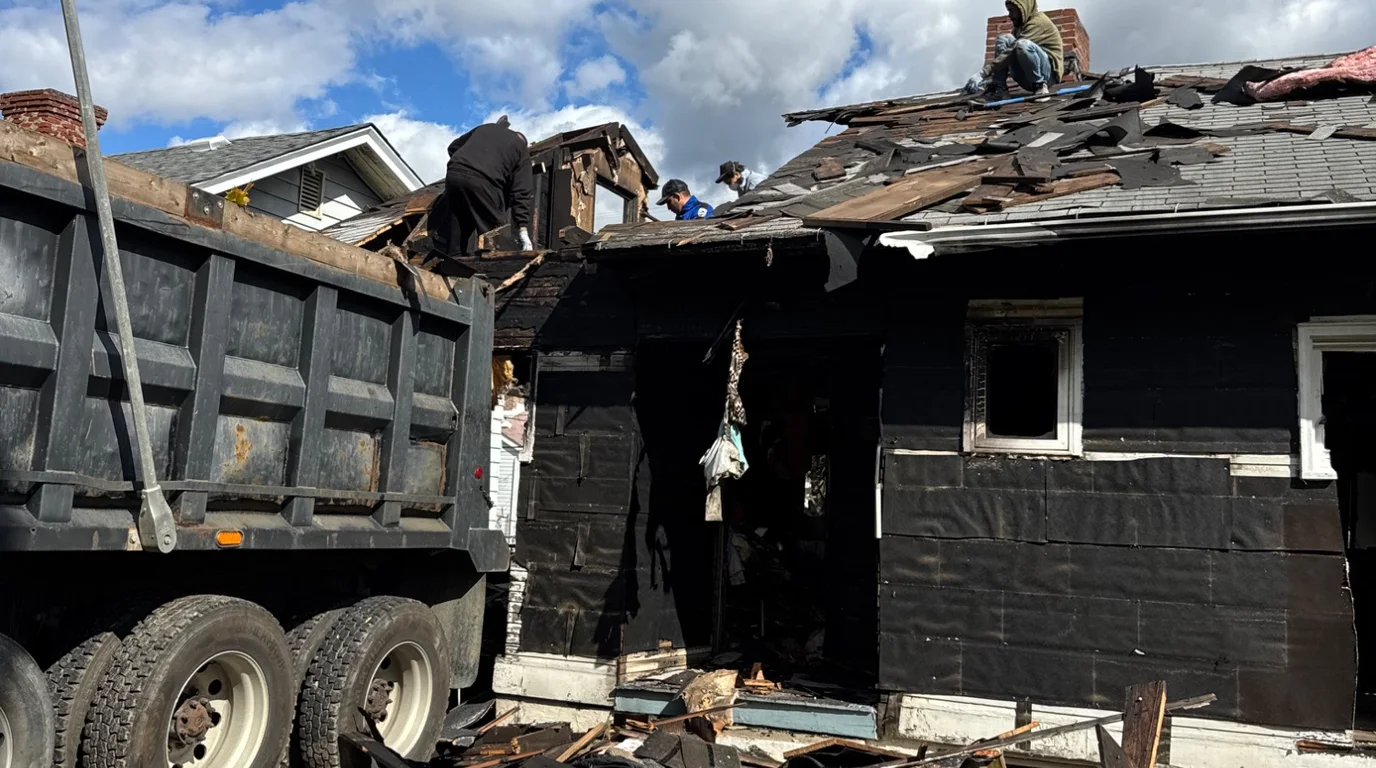
- Structural stabilization: boarding windows, tarping roof penetrations, and securing the structure against weather and unauthorized entry.
- Contents separation: salvageable items are catalogued and moved to a clean staging area; items that cannot be restored are documented for your insurance claim.
- Dry soot and wet soot removal: different soot types require different chemistry. Protein-based residue from kitchen fires, for example, is nearly invisible but produces intense odor and requires enzymatic treatment rather than standard cleaning agents.
- Odor neutralization: thermal fogging and hydroxyl generation reach into wall cavities and ductwork where surface cleaning cannot.
- Structural drying and dehumidification: water from suppression efforts is addressed concurrently, using the same moisture-mapping and drying protocols applied on water damage jobs.
- Selective demolition: charred or smoke-saturated materials that cannot be restored are removed and documented before any rebuild scope is finalized.
As an IICRC Certified Firm, the work follows established industry standards for both fire and water damage restoration, which matters when your adjuster is reviewing the scope.
Reaching Penn Hills from Pittsburgh
Katofsky Construction LLC operates out of Pittsburgh and responds to Penn Hills calls 24 hours a day. The most direct routes from the city run along Rodi Road and the Penn Hills corridors off Route 22, keeping travel time short even during off-peak hours. For properties in the residential areas along Frankstown Road or the hillside streets that branch off Lincoln Avenue, we account for the narrower access in those neighborhoods when staging equipment, particularly when a restoration vehicle and a dumpster need to share a tight residential block.
Penn Hills Insurance Coordination
Fire damage claims in Pennsylvania are typically handled under the dwelling and personal property sections of a homeowner’s policy. The documentation phase of the job, including thermal imaging reports, moisture readings, photo logs of affected materials, and itemized scope sheets, is structured to give your adjuster a clear picture of the actual loss. We communicate directly with carriers throughout the process so you are not left translating between a contractor and an insurance representative during an already stressful situation.
If your home was built before 1978, lead-safe work practices apply to any demolition of painted surfaces, a requirement that affects scope and scheduling. Katofsky Construction LLC holds IICRC certification and carries appropriate licensure, and the work is conducted in compliance with applicable Pennsylvania regulations governing disturbed materials in pre-1978 construction.
Local Note
Penn Hills homes built on the hillside streets east of the borough center often have split-level or bi-level layouts where the lower level is partially below grade. When fire suppression water runs downhill through the structure and collects in that lower level, it can sit against a concrete block foundation for hours before anyone notices. Block foundations wick moisture differently than poured concrete, and that water can migrate into the block cores and the adjacent soil before it appears on a moisture meter reading at the surface. On hillside properties in Penn Hills, we probe the lower level and the foundation perimeter as a standard part of the post-fire assessment, not as an add-on.
If a fire has affected your home or property in Penn Hills, call Katofsky Construction LLC at (412) 304-9284. We answer every hour of the day and night, assess the full scope of the damage, and walk you through the restoration process from the first call to the final inspection.
Fire Damage Restoration in Penn Hills: Service Coverage
Frequently Asked Questions
How fast can you arrive for fire damage restoration in Penn Hills?
How quickly can Katofsky Construction LLC reach a Penn Hills address after a fire?
Penn Hills has a lot of older homes with plaster walls. Does that affect how smoke damage is cleaned?
My Penn Hills home was built in the 1960s. Are there lead or asbestos concerns during fire damage restoration?
What does the fire damage restoration process look like for a typical Penn Hills split-level or bi-level home?
How does Katofsky Construction LLC work with my homeowner's insurance carrier on a Penn Hills fire claim?
Fire Damage Restoration response in Penn Hills
Most Penn Hills calls see a technician on-site within 60 minutes from our Pittsburgh headquarters.
Nearby & Related
- 24/7 Emergency Fire Damage Restoration in Pittsburgh
- Restoration Services in Penn Hills
- Roofing Installation and Replacement in Penn Hills
- 24/7 Emergency Sewage Cleanup and Sanitization in Penn Hills
- 24/7 Emergency Fire Damage Restoration in Baldwin
- 24/7 Emergency Fire Damage Restoration in Bethel Park
- Contact Katofsky Construction LLC