Lead Paint Abatement in Pittsburgh
24/7 lead paint abatement in Pittsburgh and surrounding areas. IICRC-certified, insurance billing accepted. Call (412) 304-9284.
Peeling paint on a Pittsburgh window sill or a chalky layer beneath new drywall mud might look like a cosmetic problem. In homes built before 1978, it can be a federal health hazard. Lead paint does not announce itself, and disturbing it without proper containment, whether during a renovation or a routine repair, can scatter fine lead dust across surfaces that look clean for weeks. That dust is the real danger, especially for children under six and pregnant women.
What Lead Paint Abatement actually involves
Abatement is not painting over a problem. It is the permanent elimination of a lead hazard through encapsulation, enclosure, or full removal of lead-bearing materials, followed by rigorous clearance testing to confirm the hazard is gone.
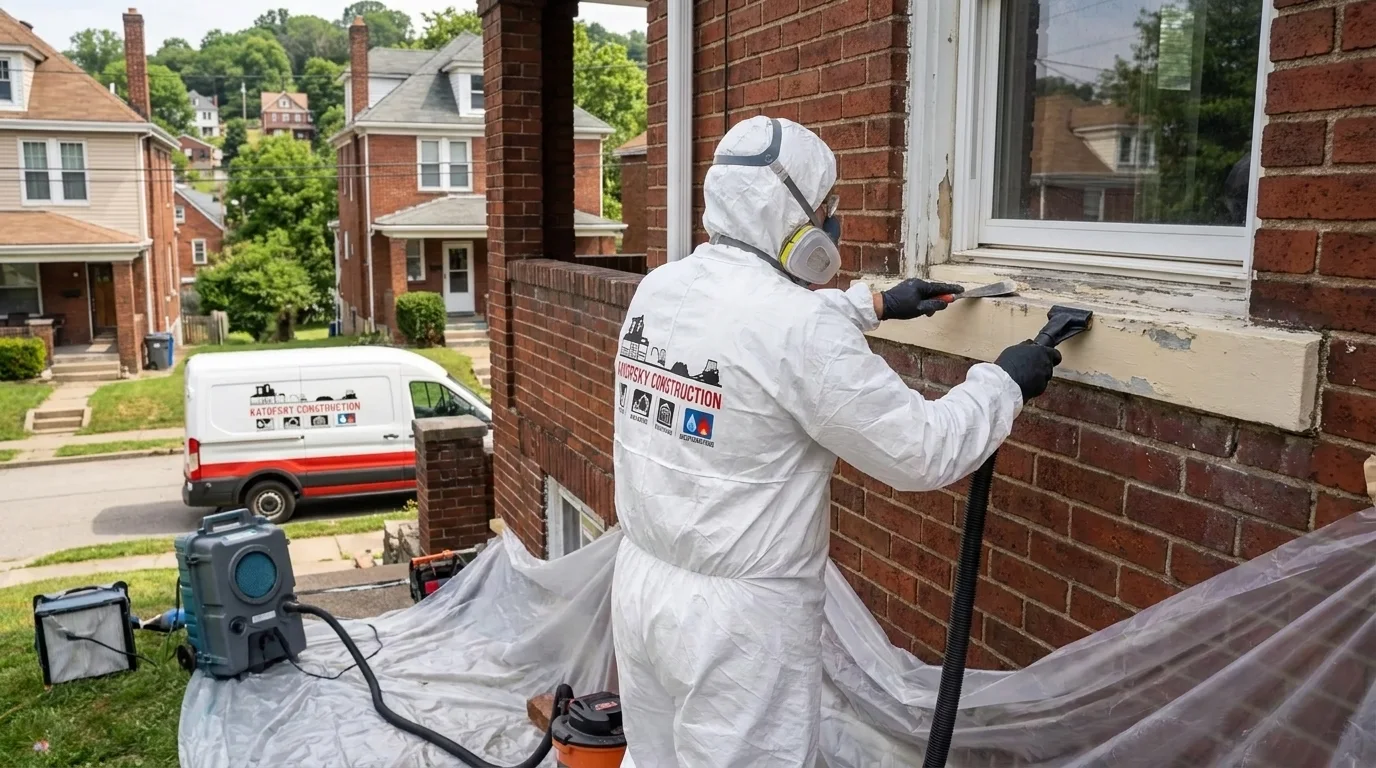
The work requires specialized equipment: HEPA-filtered vacuums rated for lead dust, negative air machines to keep disturbed particles from migrating, plastic sheeting sealed with tape at every seam, and wet-wiping protocols that prevent dry sweeping from re-suspending settled dust. Workers wear full PPE including respirators rated for lead particulate. Waste is bagged, labeled, and disposed of as hazardous material under Pennsylvania Department of Environmental Protection guidelines.
Timeline depends on the scope. A single room with deteriorated window trim and sill paint can take one to two days. A whole-house abatement on a pre-1940 Pittsburgh row home with original woodwork, plaster, and multiple layers of paint can run a week or more. The clearance wipe test, which must be performed after cleanup and before occupants return, adds another step that cannot be skipped or rushed.
Pittsburgh’s housing stock makes this service especially relevant. A large share of the city’s residential properties were built before World War II, when lead-based paint was standard on interior trim, exterior siding, window sashes, and porch floors. Older neighborhoods like Lawrenceville, Polish Hill, Bloomfield, and the South Side Slopes have dense concentrations of pre-1940 construction where multiple paint layers have been accumulating for generations.
Our process
-
Lead testing and hazard assessment. Before any work begins, surfaces are tested using XRF (X-ray fluorescence) analysis or paint chip sampling sent to an accredited laboratory. Testing identifies exactly which surfaces contain lead paint above the federal action threshold and whether the condition is intact, deteriorating, or already disturbed.
-
Scope development and permit coordination. Pennsylvania requires that abatement contractors be certified by the EPA RRP (Renovation, Repair, and Painting) program and, for full abatement projects, licensed through the state. We prepare a written scope of work identifying each affected surface, the abatement method to be used, and the disposal plan. Permits are pulled where required before work starts.
-
Containment setup. The work area is isolated with polyethylene sheeting sealed at doorways, HVAC vents, and any gaps. Negative air pressure is established using HEPA air scrubbers so that any airborne particles are drawn into filtration rather than into adjacent living spaces. Residents and pets must be out of the work area for the duration.
-
Abatement work. Depending on the surface and condition, this means wet scraping and chemical stripping of deteriorated paint, encapsulation with approved sealants on intact surfaces that are not being disturbed, or full removal of components such as window sashes or door casings that are more cost-effective to replace than to strip. All debris is wet-wiped, HEPA-vacuumed, and double-bagged as hazardous waste.
-
Clearance testing. After cleanup, a certified lead inspector or risk assessor performs wipe sampling on floors, window sills, and window troughs. Samples go to an accredited lab. Occupants do not return until written clearance is issued. This step is not optional and is not performed by the same crew that did the abatement.
What separates a good lead abatement response from a bad one
The most common failure point is treating lead abatement like ordinary demo work. Dry sanding or grinding lead paint without containment is a federal violation under the EPA RRP rule, and it creates a contamination problem that can be far more expensive to remediate than the original hazard.
A second common mistake is skipping clearance testing or using a visual inspection as a substitute. Visual inspections do not detect lead dust. Wipe sampling is the only method that confirms a surface is below the clearance standard, and any contractor who tells you otherwise is not following EPA protocol.
Insurance adjusters and public health inspectors look for a complete paper trail: the initial test results, the written scope, proof of contractor certification, waste disposal manifests, and the signed clearance report. Missing any of these documents can delay a real estate transaction, trigger a reinspection, or create liability for the property owner.
Finally, watch for contractors who quote abatement but deliver encapsulation without disclosing the difference. Encapsulation is appropriate for intact, stable paint that will not be disturbed. It is not a substitute for removal when the paint is already deteriorating or when the surface will be subject to friction, impact, or future renovation.
What does Lead Paint Abatement cost?
Typical costs vary considerably based on the number of surfaces affected, the abatement method, and the age and condition of the home. Most homeowners pay somewhere in the ranges below, based on industry-typical figures.
| Scenario | Typical range |
|---|---|
| Lead testing only (XRF or chip sampling, single unit) | $300 - $700 |
| Single room, deteriorated window trim and sill | $1,500 - $3,500 |
| Full window unit replacement (per window, lead-bearing) | $400 - $900 per window |
| Whole-room encapsulation, intact surfaces | $800 - $2,500 |
| Whole-house abatement, pre-1940 Pittsburgh row home | $8,000 - $30,000+ |
| Clearance testing (post-abatement, single unit) | $250 - $500 |
Every property is different, and Katofsky Construction LLC provides a written scope of work before any work begins so you know exactly what is included. Homeowners insurance typically does not cover lead abatement as a standalone service, but it may cover abatement costs when lead paint is disturbed as a result of a covered loss such as water damage or fire. We work with all major insurance carriers and handle the claim documentation on your behalf.
Seasonal and regional considerations
Pittsburgh’s freeze-thaw cycles accelerate paint failure on exterior surfaces. Window sills, porch floors, and exterior trim that survived decades intact can begin to crack, blister, and peel after a harsh winter, turning a stable encapsulated surface into an active hazard by spring. If your home has original exterior woodwork and you notice paint deterioration after winter, testing before any exterior work begins is the right first step.
Renovation activity also peaks in spring and summer, which is when the EPA RRP rule matters most. Any contractor performing renovation, repair, or painting work in a pre-1978 home must follow lead-safe work practices. If you are hiring trades for spring projects, confirm their RRP certification before work starts.
Service area
Katofsky Construction LLC serves Pittsburgh and the surrounding region, including the North Shore, South Hills, East End neighborhoods, and communities across Allegheny County. The city-specific service pages for individual neighborhoods and surrounding municipalities link back to this page for full process detail.
If you have identified deteriorating paint in a pre-1978 home, or if a renovation project is triggering the EPA RRP rule, call (412) 304-9284 to schedule your lead paint assessment and get a written scope before any work is disturbed.
Frequently Asked Questions
Does homeowners insurance cover lead paint abatement?
What is the difference between lead paint encapsulation and full lead paint removal, and how do I know which one my home needs?
What is clearance testing, and why can't occupants return to the home before it is done?
What does EPA RRP certification mean, and why does it matter for my renovation project?
How do I know if my Pittsburgh home has lead paint, and should I test before starting any renovation?
Looking for the best lead paint abatement company in Pittsburgh?
Katofsky Construction LLC provides licensed and insured lead paint abatement in Pittsburgh, PA and the surrounding area. We answer calls 24/7 — call (412) 304-9284 for immediate help.
Need Lead Paint Abatement now?
We respond 24/7 across Pittsburgh and surrounding PA cities.
Related Coverage
- Our Restoration Services
- Contact Katofsky Construction LLC
- Lead Paint Abatement in Baldwin
- Lead Paint Abatement in Bethel Park
- Lead Paint Abatement in Carnegie
- Lead Paint Abatement in Green Tree
- Lead Paint Abatement in Greensburg
- Lead Paint Abatement in Hempfield Township
- Lead Paint Abatement in Jeannette
- Lead Paint Abatement in Latrobe
- Lead Paint Abatement in Lower Burrell
- Lead Paint Abatement in McCandless
- Lead Paint Abatement in McKeesport
- Lead Paint Abatement in Monroeville