
Contents Restoration & Storage in Carnegie
24/7 contents restoration & storage in Carnegie, PA. IICRC-certified, insurance billing accepted. Call (412) 304-9284.
Our IICRC-certified technicians are dispatched from our Pittsburgh, PA headquarters and are typically on-site in Carnegie within 60 minutes of your call.
Carnegie sits in a valley where Chartiers Creek runs close to the borough’s older residential blocks, and the combination of low-lying terrain and aging housing stock means that when water, fire, or smoke damages a home here, the belongings inside often take the hardest hit. Furniture, clothing, documents, and keepsakes absorb smoke odor and moisture faster than the structure itself, and in a borough where many homes predate the mid-twentieth century, those contents are frequently irreplaceable. Katofsky Construction LLC handles contents restoration and storage for Carnegie property owners, moving quickly to protect what matters most before secondary damage sets in.
Why Carnegie Properties See Contents Damage More Than You’d Expect
The housing stock throughout Carnegie skews older, with a significant share of homes built between the 1920s and 1950s. Those homes were constructed with plaster walls, horsehair insulation, and wood-framed interiors that hold moisture and smoke particulate differently than modern construction. When a pipe bursts behind a plaster wall or a kitchen fire sends soot through a drafty floor plan, the smoke and water don’t stay where they started. They migrate into closets, saturate upholstered furniture, and settle into fabric, paper, and wood grain within hours.
Chartiers Creek has a documented history of flooding during heavy rain events, and homes close to the creek corridor are particularly vulnerable to basement flooding that wicks upward into finished living spaces. Contents sitting on the floor or in lower cabinets are often the first casualties, and the window between “wet but salvageable” and “a total loss” is short. Mold colonization on porous materials can begin within 24 to 48 hours of initial exposure, which is why the speed of pack-out matters as much as the restoration work itself.
Our Contents Restoration and Storage Process in Carnegie
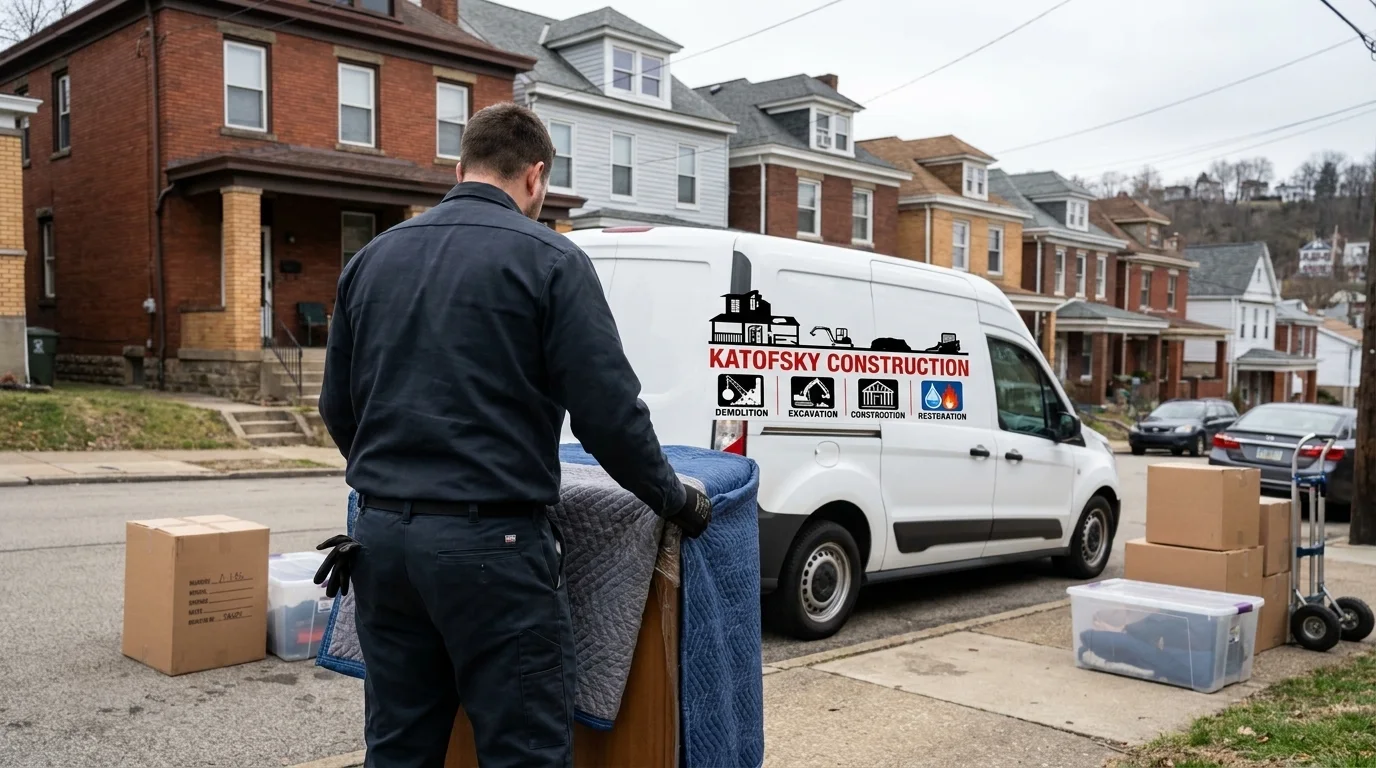
The process begins with a systematic inventory and pack-out. Every item is photographed, catalogued, and assigned a condition rating before it leaves the property. This documentation matters for insurance claims and gives you a clear record of what was removed and where it is at every stage.
From there, contents go to a climate-controlled facility where the appropriate restoration method is matched to the material. Hard goods, electronics, and furniture with structural integrity are cleaned using ultrasonic equipment, dry-ice blasting, or specialized surface treatments depending on the type and extent of damage. Textiles go through ozone or hydroxyl treatment to neutralize smoke odor at the molecular level rather than masking it. Documents and photographs, which are common in Carnegie’s older homes where family records span generations, receive priority handling and can often be stabilized and dried even when they appear severely damaged.
Items that cannot be restored are documented in detail to support your insurance claim. Nothing is discarded without your sign-off.
Reaching Carnegie from Pittsburgh
Katofsky Construction LLC operates out of Pittsburgh, and Carnegie is a straightforward run west via Carnegie Bridge and Route 50. Because the team operates around the clock, a call at any hour connects you to someone who can dispatch for emergency pack-out or schedule a same-day assessment. Getting contents out of a damaged environment quickly is the single most effective way to reduce total loss, and the short distance between Pittsburgh and Carnegie makes that turnaround realistic.
Carnegie Insurance Coordination
Contents restoration claims have more moving parts than structural claims. Carriers want itemized documentation, condition assessments, and restoration-versus-replacement cost comparisons for each item. The pack-out inventory Katofsky Construction creates from the start is built to satisfy those requirements. Adjusters receive a line-by-line record with photographs rather than a summary estimate, which typically speeds up the approval process and reduces back-and-forth.
If your carrier requires a third-party contents valuation or has a preferred vendor list, that information is worth gathering early. The documentation we provide is formatted to work with most major carriers’ claim workflows.
Local Note
Carnegie’s older homes frequently have unfinished or partially finished basements with stone or brick foundation walls rather than poured concrete. Those walls are porous, and during a flood event they allow groundwater to seep in slowly rather than rushing in all at once. The result is that contents stored in basement areas are sometimes damp for days before a homeowner notices, because the water level never rises dramatically. By the time the problem is visible, mold is often already establishing on cardboard boxes, fabric bins, and wood furniture legs. If your basement has that older stone-wall construction, it is worth checking stored contents after any significant rain event, not just after an obvious flood.
If you are dealing with smoke, water, or flood damage to your belongings in Carnegie, call Katofsky Construction LLC at (412) 304-9284. The sooner contents are removed from a damaged environment, the more of them can be saved, and the team is available any time to start the pack-out process.
Contents Restoration & Storage in Carnegie: Service Coverage
Frequently Asked Questions
How fast can you arrive for contents restoration & storage in Carnegie?
How does Carnegie's older housing stock affect which contents can be restored?
Can contents be restored after a Chartiers Creek area basement flood in Carnegie?
What happens to my belongings while they are in storage during Carnegie restoration work?
How does the contents documentation process work for a Carnegie insurance claim?
Can smoke odor really be fully removed from furniture and clothing in a Carnegie home, or does it linger?
Contents Restoration & Storage response in Carnegie
Most Carnegie calls see a technician on-site within 60 minutes from our Pittsburgh headquarters.