
Sewage backup is one of those home emergencies that triggers a very human instinct: grab a mop and deal with it yourself. Don’t. Raw sewage contains a mix of bacteria, viruses, and parasites that can cause serious illness through skin contact, inhalation, or even touching a contaminated surface and then your face. The short version is that a sewage backup is not a cleaning problem, it is a biohazard event. The equipment, protective gear, and disposal protocols required go well beyond what a hardware store run can cover. Here is what you need to know before you touch anything.
What Is Actually in Sewage Backup Water
Not all water damage is equal. Restoration professionals classify water by contamination level, and sewage backup falls into the most serious category: Category 3, sometimes called black water. This is water that carries pathogens capable of causing disease on contact.
The specific organisms present in sewage backup include:
- E. coli and Salmonella, bacterial pathogens that cause gastrointestinal illness and can enter the body through broken skin or mucous membranes
- Hepatitis A, a virus that survives on surfaces and in standing water long after the visible mess is gone
- Giardia and Cryptosporidium, parasites that are resistant to standard household disinfectants
- Rotavirus, particularly dangerous for children and elderly adults
Beyond the biological hazards, sewage gas (primarily hydrogen sulfide and methane) accumulates in enclosed spaces during a backup. At low concentrations, hydrogen sulfide smells like rotten eggs. At higher concentrations, it deadens your sense of smell first, then affects your respiratory system. This is why people sometimes feel fine walking into a sewage-affected basement and then become dizzy or nauseated without understanding why.
If the backup occurred in a basement or crawl space with limited ventilation, do not enter without opening windows and doors first and giving the space time to air out.
What Happens If You Try to Clean It Yourself
The danger is not just in the moment of cleanup. It extends forward in time in ways that are easy to underestimate.
Exposure routes you might not think about: Sewage aerosols become airborne when you pour, scrub, or run a wet-vac over contaminated water. You can inhale pathogens without realizing it. If you are not wearing an N95 respirator or better, you are breathing contaminated air.
Surfaces that look clean are not: Pathogens soak into porous materials including drywall, subflooring, insulation, and wood framing. Wiping down a surface with bleach water does not reach contamination that has wicked several inches into a wall cavity or under a floor. That material needs to be removed, not sanitized in place.
Secondary mold growth: Sewage backup leaves behind moisture that, in Pittsburgh’s humid summers, can support mold colonization within 24 to 48 hours. Mold that develops inside a wall cavity after a sewage event is not ordinary household mold. It is growing in a nutrient-rich environment and can spread aggressively before you see or smell it.
Waste disposal is regulated: In Pennsylvania, materials contaminated with sewage are classified as regulated waste. You cannot bag them and put them at the curb. Improper disposal can result in fines and creates a hazard for sanitation workers.
What You Should Do Immediately (Before Professionals Arrive)
There are safe, useful steps you can take right now that do not require entering the contaminated area.
- Stop using all water in the house. Running faucets, flushing toilets, or running the dishwasher adds volume to a backed-up system. Shut off the water supply to the house at the main shutoff valve if you are not sure what caused the backup.
- Do not use any drains. Even drains in rooms that appear unaffected can push additional sewage into the backup area.
- Open windows and exterior doors in the affected area if you can do so without entering the contaminated zone. Ventilation reduces gas buildup.
- Keep children and pets out of the affected area entirely. Children are more vulnerable to the pathogens in sewage, and pets can track contamination through the house.
- Document with photos before anything is moved or cleaned. Your insurance claim will depend on photographic evidence of the extent and origin of the damage. Take photos from the doorway without entering.
- Call your insurance company. Sewage backup coverage varies by policy. Many standard homeowners policies exclude it unless you have a sewer backup rider. Knowing your coverage before cleanup begins affects what documentation you need.
What Not to Do
Some common instincts make the situation worse.
- Do not run a standard shop vac or household wet-vac. These machines are not sealed for biohazard material. They exhaust contaminated aerosols back into the air and are nearly impossible to decontaminate afterward.
- Do not use a plunger if the backup is widespread. Plunging a toilet when the line is fully backed up forces sewage further into the drain system and can push it up through other fixtures.
- Do not apply bleach as a first response. Bleach on organic material like sewage produces chloramine gases and does not penetrate porous surfaces. It creates a false sense of decontamination.
- Do not run your HVAC system. If sewage gases or aerosolized pathogens are present, the HVAC system will distribute them through the house.
- Do not assume the problem is resolved once the water recedes. Standing sewage water is the visible part. The contamination that has soaked into materials underneath is the part that causes long-term health and structural problems.
When to Call a Professional and What They Actually Do
If the backup has affected more than a small, hard-surface area (a single tile floor, for example), professional sewage cleanup is the appropriate response. That threshold is lower than most people expect.
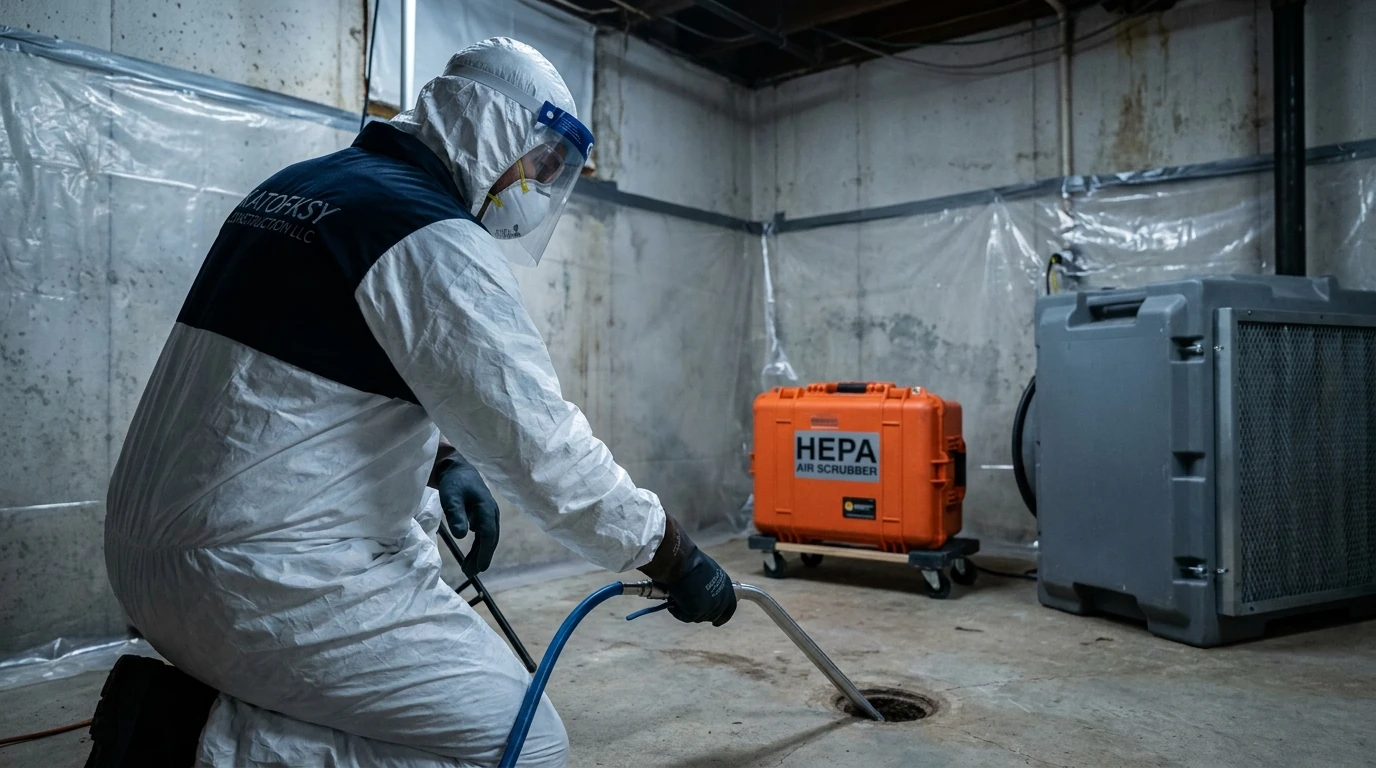
A professional sewage cleanup team arrives with personal protective equipment rated for biohazard work, including Tyvek suits, gloves, and respirators. They use commercial-grade extraction equipment that is sealed and filterable. The process typically involves:
- Extracting standing water with equipment designed for contaminated material
- Removing and bagging affected porous materials (drywall, insulation, flooring) for regulated disposal
- Applying EPA-registered antimicrobial treatments to structural surfaces
- Using industrial air movers and dehumidifiers to dry the space to measurable moisture levels
- Conducting clearance testing to confirm contamination has been addressed before any rebuild begins
The drying phase matters as much as the extraction phase. Moisture meters and thermal imaging cameras can detect saturation behind walls and under floors that look and feel dry at the surface. Skipping this step is how a sewage cleanup becomes a mold remediation six weeks later.
Katofsky Construction LLC handles sewage cleanup in Pittsburgh and the surrounding area. If you are dealing with a backup now, call (412) 304-9284.
A Note on Pittsburgh Basements Specifically
A large share of Pittsburgh’s residential housing stock was built before the mid-20th century, and many of those homes have older clay or cast-iron sewer laterals connecting to the municipal system. These laterals deteriorate over time and are susceptible to root intrusion and joint failure. Pittsburgh’s topography, with its hills and older combined sewer infrastructure in many neighborhoods, also means that heavy rain events can overwhelm the system and push sewage back through floor drains and low-lying fixtures.
If you have experienced one sewage backup, the underlying cause of that backup is worth investigating. A plumber can scope the lateral with a camera to determine whether root intrusion or pipe deterioration is the source, which affects whether you are looking at a one-time event or a recurring problem.
Sewage backup is one of the few home emergencies where the instinct to handle it yourself can genuinely make you sick. The health risks are real, the contamination goes deeper than it looks, and the cleanup requires equipment and disposal protocols that are not available at a hardware store. If you are in the Pittsburgh area and dealing with a backup, the safest call is to a professional sewage cleanup service before you enter the affected space. Katofsky Construction LLC can be reached at (412) 304-9284.